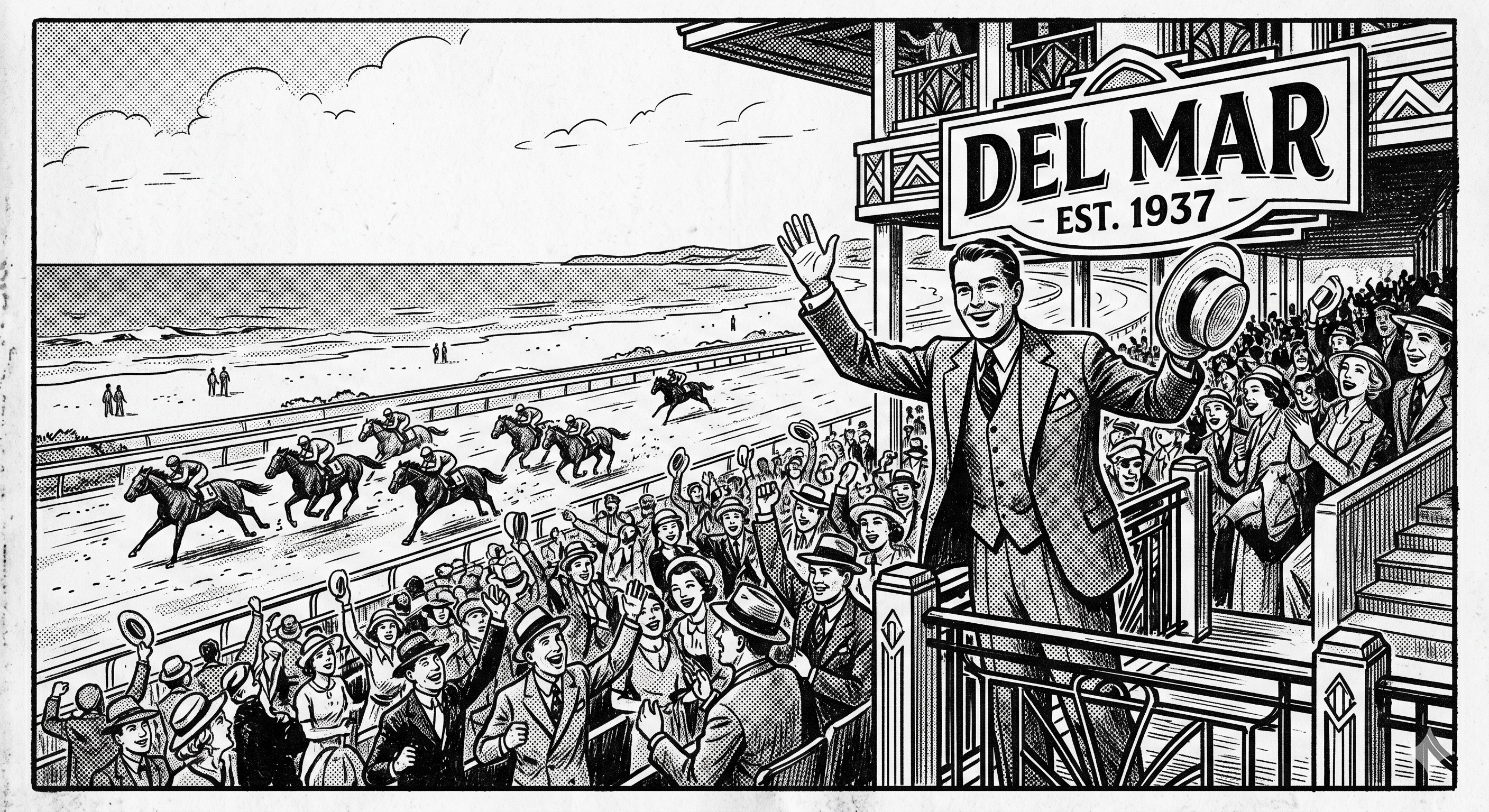
The first man through the gate at Del Mar on July 3, 1937, handed his ticket to Bing Crosby.
That's not an exaggeration. Crosby himself stood at the turnstile of his own racetrack on opening day. He'd shake your hand, collect your stub, and crack a joke before waving you through. Fifteen thousand people came that afternoon. Barbara Stanwyck handed out the trophy for the Inaugural Handicap. Bette Davis watched from the clubhouse. Oliver Hardy stood in the steward's stand because somebody had to, and Oliver Hardy had always wanted to.
The whole thing shouldn't have existed. A racetrack on the sand, twenty miles north of San Diego, built where the surf comes within a drive and a three-wood of the far turn. But a La Jolla stockbroker named Bill Quigley had an idea, and he pitched it to Crosby in 1936, and within a year they'd gotten it built with borrowed money and good faith. Crosby and Pat O'Brien had taken out loans against their own life insurance policies to finish the grandstand. Hardy was on the board. So was Gary Cooper. Charles Howard came in with his son Lindsay. The Works Progress Administration laid the foundation. The 22nd District Agricultural Association owned the land. And when the gate opened that first morning, Bing was right there because he believed in the thing he'd built.
Eighty-nine summers later, his voice still plays before the first race.
The Dream Was a Beach, Not a Racetrack
Santa Anita had opened Christmas Day 1934. It sat inland, up against the San Gabriels, and it had everything Hollywood wanted except the ocean. Quigley had been a part-time steward there. He watched the racing crowd drive past the coast on their way home to Los Angeles and thought: why are we going the wrong direction?
So they built it the other way. Right at the mouth of the San Dieguito River, on a 184-acre stretch of coastal flatland where Del Mar had been trying for years to find an identity. Colonel Ed Fletcher, who'd developed the town's first subdivision in 1908, championed the site. The fairgrounds were built with WPA money. The track itself cost about six hundred thousand dollars, most of it raised privately, some of it borrowed against the personal finances of two Irish-Catholic movie stars. The architects were Sam Hamill and H.L. Jackson. They gave it Spanish Colonial Revival bones and tan stucco skin because that was California in 1937.
And that was the whole point. Crosby wanted a place where you could drive down from Beverly Hills on a Friday, stay in a bungalow through the weekend, bet a little, win a little, and walk to the beach between races. A resort wrapped around a racetrack. A racetrack wrapped around a summer. Today you can still stand at the Hilton San Diego/Del Mar or L'Auberge Del Mar and see what he saw. The ocean's a two-minute walk from most Del Mar hotels. The sand is where the horses stop and the surfers start.
August 12, 1938: Father Against Son
The race that put Del Mar on the map happened in its second summer, and it should've been a disaster.
Charles Howard owned Seabiscuit. Everyone knew Seabiscuit by then. He was the most-photographed creature in America, and he was already rewriting what a racehorse could mean to a country trying to claw out of the Depression. Howard's son Lindsay, who was twenty-nine and competitive and maybe a little tired of living in his father's shadow, went in with Bing Crosby on a big Argentine colt named Ligaroti. They'd named their stable Binglin. Bing and Lin. The colt was good. Not Seabiscuit good, but good.
The match race was set for a Friday afternoon. Twenty thousand people crammed into a track built for less. Crosby and Pat O'Brien climbed up on the grandstand roof and called the race live for NBC radio. The purse was twenty-five thousand dollars. Winner took all. No betting.
They broke together. They ran together. A mile and an eighth, head and head the whole way. And somewhere in the stretch the jockeys went to war. Ligaroti's rider, a bespectacled cowboy named Noel Richardson, reached over and grabbed Seabiscuit's saddlecloth to slow him down. Seabiscuit's jockey, the great George Woolf, reached back and grabbed Ligaroti's bridle. They were still grabbing each other when they hit the wire. Seabiscuit won by a nose in a track record 1:49 flat. Nobody could believe what they'd just seen.
The stewards sat on the decision for six days. They fined both jockeys. They suspended both jockeys. Then they quietly unsuspended them because no public money had been bet and the film showed Richardson had started it. The result stood. But after that Del Mar didn't host another match race for fifty-six years, because nobody wanted to write that kind of ending twice.
It was Seabiscuit's only start at Del Mar. Charles and Lindsay Howard stayed friends. So did Tom Smith, who trained Seabiscuit, and Jimmy Smith, his son, who trained Ligaroti. That was the day the little seaside track stopped being Bing Crosby's experiment and started being somewhere legends came to run.
The Song
The song came in 1938 too. Crosby wrote it with Johnny Burke and Jimmy Monaco, the same team that wrote "Pennies From Heaven." It was three verses long and it was barely a song at all. Take a plane. Take a train. Take a car. There's a smile on every face and a winner in each race. Where the turf meets the surf at Del Mar.
That was it. No great poetry. No complicated rhymes. Just a crooner telling America there was a place out there where they could come be happy for a few hours.
It still plays. Every race day. Before the first post and after the last one. You walk into the grandstand and Bing Crosby, who's been dead since 1977, welcomes you in person. You walk out and he says goodbye. Kids grow up hearing it. They get older and bring their own kids. Those kids grow up and bring their own. The song hasn't changed in eighty-eight years, and neither has the voice singing it.
The Horses Left
Del Mar went dark on the last day of 1941's season. The Marines moved in first, using the barns and grandstand as training quarters. Then the Del Mar Turf Club Aircraft Division set up assembly lines right inside the grandstand to build wing ribs for B-17 bombers. For three summers the most glamorous racetrack in the West smelled of aluminum and gun oil. The horses went to Arlington, to Keeneland, to wherever the war hadn't reached yet.
Racing came back on August 15, 1945. Which was also the day Japan surrendered. Which was also the day President Truman declared a national holiday. Twenty thousand three hundred and twenty-four people showed up to Del Mar that afternoon and bet nearly a million dollars. They'd saved it up for four years, and the first thing they did with it was come to the races.
Bing Crosby sold his stock in the track the following April. He got out of the business end. But he never really left. He came back every summer for the rest of his life. The last time he walked through the gate he'd once manned himself was during the 1977 meet. He died that October on a golf course outside Madrid. His last words were reportedly that he'd had a great game, and that the boys should all go have a Coca-Cola.
The Hollywood Years
The names tell you everything about what Del Mar meant in the forties and fifties. Ava Gardner. Dorothy Lamour. W.C. Fields. Paulette Goddard. Red Skelton. Edgar Bergen. Lucille Ball and Desi Arnaz would drive down from LA most weekends. Betty Grable bought a house on the beach specifically so she could walk to the track. Mickey Rooney flew his own Piper Cub down from Los Angeles to catch a race or two in the afternoon and fly back the same night.
And Jimmy Durante. Durante became so much a part of the place that they eventually named the turf course after him, in 1960. A few years later they named the main road in after him too. If you've ever driven to the track, you've driven down Jimmy Durante Boulevard. That's why.
The racetrack was what America's most famous people did on their time off. Fred Astaire bred horses there. Barbara Stanwyck bred horses there. Burt Bacharach got into the game in 1968 and stayed in it until he died at ninety-four, and his filly Heartlight No. One won the Del Mar Oaks in 1983 and took home the Eclipse Award for three-year-old filly of the year. Bacharach once said Del Mar was where he went to swim in the ocean between races. A songwriter in a house on the beach, walking down to watch his own horses run.
Joe Harper runs the place now. He's the grandson of Cecil B. DeMille. Played a slave in the 1956 Ten Commandments when he was eleven. He took over Del Mar in 1977, the same year Crosby died, and he's still there. Bob Baffert once said Joe Harper is Del Mar. Del Mar is Joe Harper.
The Modern Legends
The Pacific Classic started in 1991. A million-dollar race, the richest in California history at the time, a mile and a quarter on the dirt on a Saturday in August. Best Pal won the inaugural as the only three-year-old in the field, rallying in deep stretch for trainer Gary Jones, and the crowd came off its feet.
Five years later, on August 10, 1996, forty-four thousand people packed into Del Mar to watch Cigar try to break Citation's record of sixteen straight wins. Cigar was one-to-ten that day. Everyone knew he was going to do it. Except he didn't. A 39-1 shot named Dare and Go, trained by Richard Mandella, beat him by three and a half lengths. Alex Solis rode Dare and Go and said afterward that he was glad he'd won, but it was kind of sad, because Cigar had been a hero to them all.
In 2003 an Argentine-bred named Candy Ride ran the Pacific Classic in 1:59.11 under Julie Krone. Krone became the first woman ever to win a million-dollar race that day. Candy Ride's time has stood as the track record for twenty-three years. Flightline came within two-tenths of a second of it in 2022 and still lost by nineteen and a quarter lengths more than anyone else. Zenyatta won the Clement L. Hirsch three years running. Beholder became the first female to win the Pacific Classic in 2015, beating the boys by eight and a quarter. California Chrome, a Derby winner, swept the San Diego Handicap and the Pacific Classic in 2016. The list runs long and it keeps growing.
Del Mar has hosted the Breeders' Cup four times now. The 2025 event brought a hundred and twenty-five million dollars in economic impact for San Diego County. Horses that had run at Ascot and Chantilly and Tokyo flew into a little coastal town to race where Bing Crosby used to greet the fans at the gate.
What a Father Tells His Daughter
There's a reason people cry at Del Mar.
Ask anyone who's been going for twenty years and they'll tell you the same thing. A day at the track is one of the last places in American life where a grandfather can sit next to a grandson and explain something real. How to read a program. What a Beyer Speed Figure means. Why the five horse keeps looking at the four horse in the paddock. How to pick a longshot by looking at its ears. These things don't matter anywhere else in the world. They matter at Del Mar.
Mothers bring daughters for the hats. The hat contest turned thirty-one years old last summer. A woman named Lili Martindale from Del Mar won the grand prize in 2025 with a Monet-inspired flower confection she'd made by hand. Women bring out hats their grandmothers wore. Little girls wear hats their mothers bought them. The contest isn't the point. The point is that you get dressed up to go somewhere beautiful with the people you love, and that's worth doing for its own sake.
Kids seventeen and under get in free. Family Fun Day is July 26 this year. There's a mascot named Pony Boy. There's a kids' camp where five-to-twelve-year-olds can spend the day and eat lunch and decorate a T-shirt while their parents watch the races. A family of four can walk through the gate for fifteen dollars. Walk three hundred yards toward the stretch and you'll see horses galloping past at thirty-five miles an hour with the Pacific Ocean visible over the infield. There is nowhere else in North America you can do this. Del Mar is the only seaside racetrack in the country.
People talk about Opening Day as San Diego's unofficial holiday. That undersells it. Opening Day is the day San Diego remembers it's a beach town that built a cathedral to a sport older than the state itself. People come in dresses their mothers wore. They bring babies in strollers. They bring parents who can barely walk. They take pictures in the same spots their grandparents took pictures in 1952.
Last summer a man named Mervin Morris told a local TV station he'd been coming to Opening Day for close to thirty years. His wife Michelle cut in. "It's a Morris holiday," she said. "All of our kids, our grandkids, have been here. It's just the best in the world."
That's the whole thing right there. Thirty years of one family making a pilgrimage to a coastal racetrack in a little town north of San Diego. Multiply that by every family in Southern California who has a story like it. Multiply it by eighty-nine summers.
Opening Day 2026
The Del Mar Thoroughbred Club announced the 2026 summer season yesterday. Opening Day is Friday, July 17. The meet runs through Labor Day on September 7. Thirty-seven stakes races, seven million seven hundred and seventy-five thousand dollars in purses. The Pacific Classic moves earlier this year to Saturday, August 22. The Bing Crosby Stakes runs July 25. Clement L. Hirsch on August 1. Del Mar Oaks on August 22. Del Mar Futurity on September 6.
Tickets go on sale Friday, May 8 at ten in the morning Pacific time. General admission starts at ten dollars. Opening Day will have a new VIP party in the Seabiscuit Skyroom on the grandstand's sixth floor, where you can see the track on one side and the ocean on the other. Family Fun Day moves up to July 26. A new BBQ and Beer Fest lands on September 5. Turf and Surf Fest debuts August 8.
The Fall Meet, the Bing Crosby Season, comes back November 6 through November 29.
If you're making a trip of it, book a room at Hilton San Diego/Del Mar or L'Auberge Del Mar. Stay at Hotel Indigo or Best Western Premier Hotel Del Mar. For dinner before the races, go to Jake's Del Mar and sit as close to the sand as they'll let you. Go to Poseidon on the Beach and order the fish. Go to Pacifica Del Mar or Brigantine Seafood & Oyster Bar for the oysters. Walk to Il Fornaio for the handmade pasta. Stop in at Viewpoint Brewing Company for the pale ale. Del Mar's dining scene runs deep. So does its local culture.
The Rest of the Story
The Del Mar Fairgrounds sits on the same 370-acre coastal property it always has. The County Fair still opens in May. Racing still begins in July. The grounds go dark in December and wake up again in spring. The Sound, a 1,900-capacity music venue, opened on the property in 2023. The Del Mar Horsepark runs year-round. The Thoroughbred Owners of California keep their offices there.
But the part that matters hasn't changed.
Bing Crosby's voice still plays at two o'clock every race day during the summer. The hats still come out on the third Friday of July. Fathers still teach sons how to read the Racing Form in the grandstand at Del Mar Racing. Mothers still hold daughters' hands walking up the ramp. Grandparents still point at the tote board and explain what the numbers mean. The ocean is still four hundred yards from the clubhouse turn. The Torrey Pines State Natural Reserve is still right down the beach.
And somewhere between the sixth and seventh race on Opening Day, if you stop for a second and listen past the crowd, you'll hear a seventy-year-old woman in a flowered hat explaining to her granddaughter which horse to cheer for, and why, and how she remembers doing the same thing with her own grandmother in 1962.
That's the whole story.
Take a plane. Take a train. Take a car.
Come to Del Mar.