There is a specific kind of restaurant story that cuts through the noise — not the one about the celebrity chef or the venture-backed concept, but the one about a family that has been doing one thing exceptionally well for three decades and is finally bringing it to your neighborhood. Telefèric Barcelona, the Spanish tapas and paella concept opening this spring at Westfield UTC in La Jolla, is that story. It is a restaurant born in a small town outside Barcelona in 1992, built by a Basque mother who introduced an entire region to the bite-sized skewered snacks called pintxos, and now run by her children — a brother-and-sister team who have expanded the brand to ten locations across California, Arizona, and Spain without ever losing the thing that made the original work: the feeling that you have walked into someone's very good house in Catalonia and they are not going to let you leave hungry.
The La Jolla location will sit on the upper level of Westfield UTC's new luxury wing, directly above JOEY La Jolla and within the stretch of La Jolla Village Drive that now hosts Chanel, Tom Ford, and Saint Laurent. It is the restaurant's first location in San Diego County and part of a broader push into Southern California coastal markets that already includes Brentwood and Long Beach. For a La Jolla dining community anchored by landmarks like George's at the Cove and Eddie V's Prime Seafood — and the Del Mar dining corridor just a few miles north — the arrival of Telefèric Barcelona fills a gap that has quietly existed for years: genuine, uncompromising Spanish cuisine run by people who were raised in the tradition, not chefs who studied it on a trip.
A Basque Mother, a Toy Cable Car, and the Pintxos That Changed Catalonia
The origin story matters because it explains everything about how Telefèric Barcelona operates. Soledad Urabayen Arza, the Padrosa family matriarch, grew up in Pamplona in Spain's Basque Country — the northern region where pintxos are not appetizers but a way of life, served on toothpicks at crowded bars alongside glasses of txakoli wine. When she and her husband opened their first restaurant in Sant Cugat, a town northwest of Barcelona, in 1992, she did something that had not been done in Catalonia: she put pintxos on the menu. These small bites — always skewered, always meant to be eaten standing — were the foundation of Basque food culture, but they had not traveled south to Barcelona in any meaningful way. The Padrosa restaurant changed that. The pintxos drew crowds. The restaurant became a landmark. And the family became, in a very real sense, the people who brought an entire culinary tradition across a regional border.
The name itself came by accident. A toy cable car — a telefèric, in Catalan — hung as decoration inside the original restaurant, shuttling back and forth above the bar. Regulars stopped calling the place by its actual name and started referring to it as "the telefèric place." The family leaned in. When Soledad's children, Xavi and Maria Padrosa, eventually took over and expanded, every location carried the name. It stuck because it captured something essential about what the restaurant does: it transports you. Not in the overwrought, theme-park way that lesser restaurants attempt, but in the way that a perfectly assembled plate of Galician octopus with truffle oil and pimentón potato purée, served by a waiter who grew up in Barcelona and greets you with an unforced "Hola," can make La Jolla Village Drive feel very far from California.
The Tennis Scholarship That Built a Restaurant Empire
Xavi Padrosa, the youngest of the siblings, is the operational engine behind the U.S. expansion, and his path to California is the kind of story that sounds invented until you check the details. A competitive tennis player, he moved to the Bay Area on an athletic scholarship and fell for the United States — not as a market to conquer, but as a place to live. The idea of opening a restaurant that could make Spanish expats feel at home while introducing Americans to the real version of the cuisine grew slowly, then became a fixation. In 2016, he and Maria opened the first U.S. location in downtown Walnut Creek. Palo Alto followed in 2019. Then Los Gatos. Then Los Angeles. Then Long Beach. Then Scottsdale. Each time, the formula stayed the same: import everything from Spain.
That word — everything — is not marketing copy. The tiles on the floors come from Spain. The furniture comes from Spain. Maria Padrosa, who handles design and architecture for every location, works with Spanish architects and sources every material directly from the Mediterranean. The management team is recruited from Spain. The chefs are recruited from Spain. Executive Chef Oscar Cabezas is from Barcelona. The family owns a winery in La Rioja, Spain's most celebrated wine region, and their Catalonian sommeliers curate a list of more than 100 Spanish wine references exclusively from Iberian producers. When Xavi says the restaurant offers "a trip to Spain with no passport required," he means the supply chain, the payroll, and the ceramics — not just the paella. For the La Jolla crowd that flies to Barcelona and San Sebastián the way other people drive to Palm Springs, this level of sourcing authenticity is not a novelty. It is the baseline expectation.
What Arrives on the Table
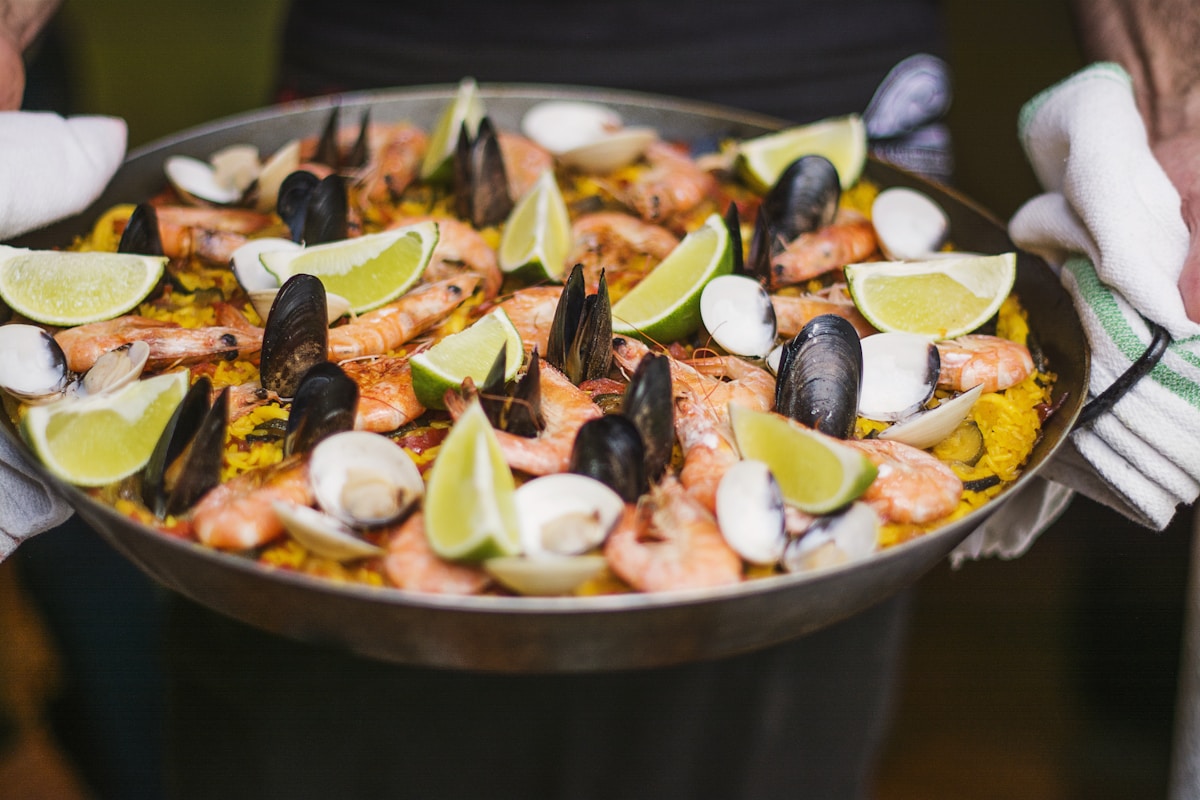
The menu is built around three pillars: pintxos, tapas, and paella. The pintxos — those skewered bites that Xavi's mother brought to Catalonia more than thirty years ago — anchor the bar experience and are the ideal entry point for first-time guests. The tapas range from Jamón Ibérico sliced to order to crab croquetas topped with tuna sashimi and spicy aioli to the restaurant's signature Pulpo Telefèric, a preparation of Galician octopus that has become a calling card across all ten locations. The paella program offers seven varieties, including a Paella Negra made with squid ink, gulf shrimp, scallops, and clams — finished with tuna sashimi and octopus at select locations. Award-winning tuna tartare tacos round out a menu that balances the deeply traditional with the cleverly modern. The cocktail program puts inventive turns on Spanish staples: a Barceloneta Sangria built with prickly pear, honey, and rosemary, and an Ibiza Gin and Tonic made with butterfly pea tea gin, orange peel, and juniper.
For the stretch of coast that runs from La Jolla's established dining rooms through Del Mar's restaurant row, this is a cuisine category that has been quietly underrepresented at this level. San Diego has extraordinary Mexican kitchens — Puesto La Jolla on Wall Street alone draws nearly 5,000 reviews. The county runs deep on Japanese at spots like Himitsu and Shimbashi Izakaya in Del Mar. Italian is well-covered from Catania on Girard Avenue to Osteria Romantica on Avenida De La Playa to Il Fornaio in Del Mar. The seafood bench stretches from Eddie V's and The Marine Room in La Jolla through Pacifica Del Mar and Poseidon on the Beach in Del Mar. What the corridor has lacked — and what Telefèric fills — is an authentic Spanish restaurant of this pedigree, with this level of sourcing integrity, run by a family that has been perfecting the craft since before most of San Diego's current dining establishments opened their doors.
Flamenco, a Spanish Market, and the Cultural Play
Telefèric Barcelona does not stop at the kitchen door. At several of its California locations, the restaurant hosts Flamenco Nights featuring Emmy Award-winning dancer Yaelisa and guitarist Jason McGuire of the performance company Caminos Flamencos — and if the brand's track record is any guide, La Jolla will get its own programming. Several locations also include an attached Spanish market where guests can purchase imported goods: olive oils, Spanish cookbooks, housemade sangria to go, gazpacho, and specialty items sourced from the same suppliers that stock the kitchen. It is a model that turns a restaurant into a cultural outpost, and for a La Jolla community where international travel is habitual and culinary standards are non-negotiable — where A.R. Valentien at the Lodge at Torrey Pines and NINE-TEN at the Grande Colonial have been setting the bar for decades — that approach carries real weight.
An exact opening date for the La Jolla location has not been publicly confirmed, though the restaurant is expected to debut this spring alongside the phased rollout of Westfield UTC's luxury expansion. The space is located at 4545 La Jolla Village Drive, Suite E-25, on the upper level of the new wing directly above JOEY La Jolla. When it arrives, it will join a growing cluster of destination restaurants at UTC — a corridor that is rapidly reshaping expectations for what a San Diego shopping center can deliver.
For the complete La Jolla dining directory — from The Cottage on Fay Avenue to Shorehouse Kitchen on Avenida De La Playa to Cove House on Girard — and the full Del Mar dining scene including Jake's Del Mar, Sbicca, and MARKET, San Diego Lineup tracks every opening, every shift, and every kitchen worth knowing about across both communities.