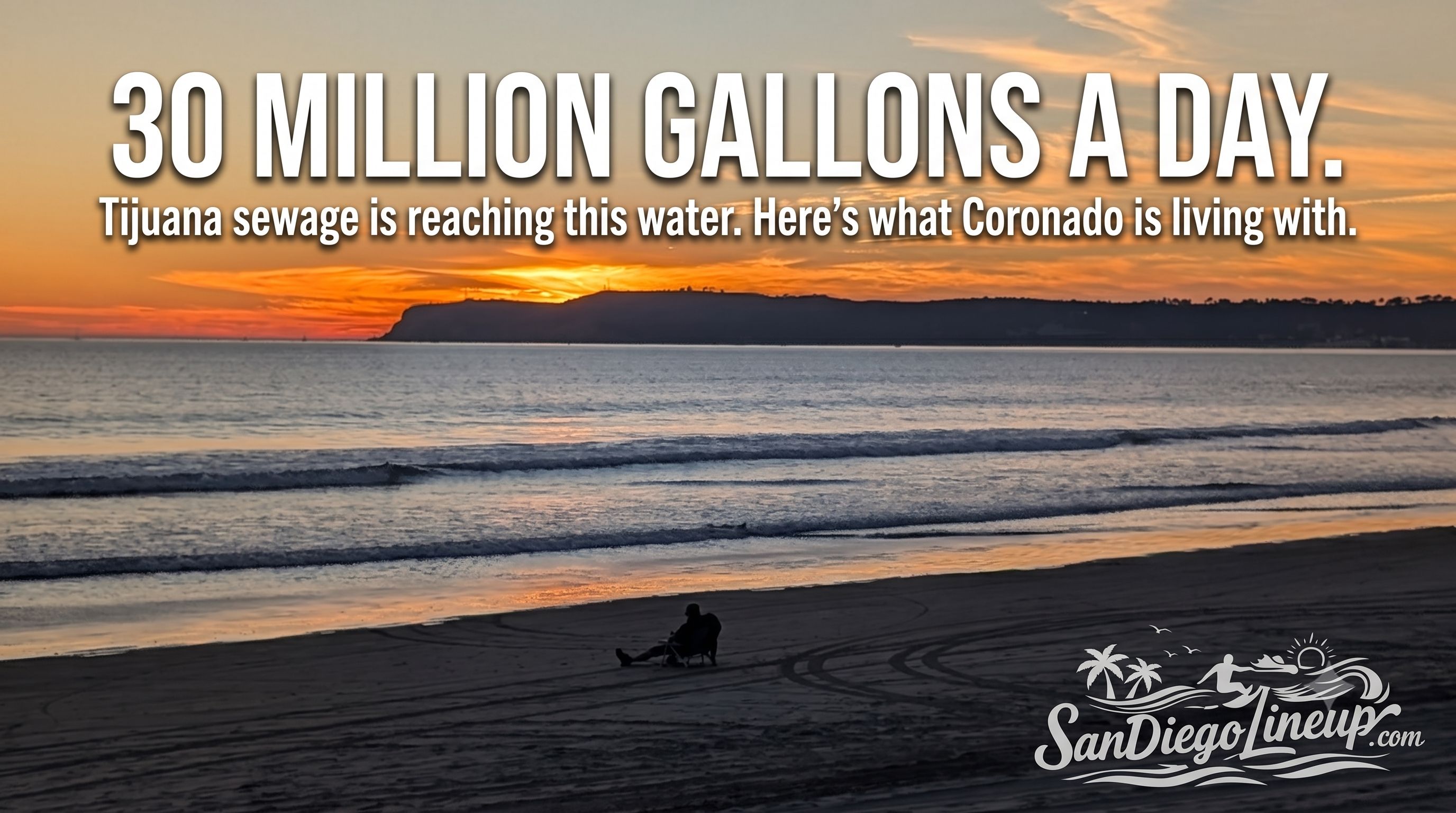
My wife and I ride our Electra beach cruisers to the Del almost every evening. Same route. Down J Ave to 6th, over to Coronado Ave, south on Ocean Blvd until we can see the tower. No electric assist. We like the pedaling. We park near the water, watch the tourists line up for their sunset photos, and remind ourselves how lucky we are to live here. Coronado Beach at golden hour is one of those places that makes you forget everything else. The sand goes copper. Point Loma turns into a silhouette across the bay. Some guy in a beach chair sits there like he owns the whole Pacific.
We've done this for years. It's our thing.
But something's off. The sunsets haven't changed. The water has. On too many evenings now, the tide rolls in with a greenish-brown tint that has no business being near this beach. And on the wrong night, when the wind comes from the south, you can smell it before you see it. Sour. Rotten. It settles over the sand and it stays.
I've been swimming in the Pacific my whole life. Born and raised in San Diego, sixty-plus years of salt water. You don't need a lab test to know something's wrong. You can see it. You can smell it. The water doesn't look the way it's supposed to look, and it hasn't for a while now.
That's sewage. From Tijuana.
My granddaughter Goldie flew in from Pittsburgh this summer. She's never seen the Pacific. I wanted to take her out in the waves, let her feel what a California beach is supposed to feel like. I couldn't do it. Yellow signs from the county were posted along the shoreline: Water Contact May Cause Illness. So we sat on the sand and watched from a distance while I tried to explain why one of the top ten beaches in America was too dirty to touch. She handled it better than I did. We walked up to MooTime Creamery on Orange Avenue and split a chocolate ice cream instead, which is what Pop Pop does when he doesn't have a good answer.
I still don't have one.
I'm not a politician. I'm not an activist. I'm a guy who lives on Coronado Island, rides his bike to the beach, and has been paying attention to this for a long time. This is what I know about the sewage crisis that's hitting our coastline, what it's doing to the people and businesses on this island, and where things stand as of this summer. Some of this I've seen with my own eyes. Some of it I've read in the Coronado Times and the local news. Some of it I've dug up because it made me angry enough to look. If you live here, own a business here, or plan to visit, you should know this stuff.
How Tijuana's Sewage Reaches Coronado Beach
The short version is ugly. Tijuana's sewage system can't keep up with the city. Over the past 30 years, Tijuana's population has roughly doubled to about 2.3 million people, and the pipes, pumps, and treatment plants were never built for that kind of load. When the system breaks down, and it breaks down often, untreated wastewater pours into the Tijuana River, crosses the international border into California, and flows out into the Pacific. Coastal currents push it north. Imperial Beach gets hit first. Then Silver Strand. Then us.
The volume is hard to wrap your head around. On bad days, as much as 30 million gallons of sewage-contaminated water can enter the ocean from the Tijuana watershed. I've seen different estimates, but one figure that keeps coming up is that over 100 billion gallons of raw sewage have crossed the border since 2018. Billion. With a B.
There's an American treatment plant that's supposed to catch what Mexico can't handle. The South Bay International Wastewater Treatment Plant, down in south San Diego, was built to process about 25 million gallons per day. They bumped it up to 35 million in an emergency expansion. But this past May, a critical sewer line in Tijuana called the Parallel Gravity Line collapsed. Then it collapsed again two weeks later. I read that peak flows to the South Bay plant topped 60 million gallons in a single day. Almost double what it was designed for. The math stopped working, and our coastline paid for it.
129 Beach Closure Days in a Single Year
The county tracks beach closures. I check their advisory page on my phone before we ride over now, which is a habit I never thought I'd need on Coronado. Their numbers tell the story.
Between 2020 and 2025, Coronado Beach averaged about 73 closure days per year. In 2025, the count hit 129. A lot of those fell in peak summer, right when families are booking flights and hotel rooms to spend a week at the beach.
South of us it's worse. Silver Strand averaged around 152 closure days per year over that stretch. Imperial Beach averaged 231. The beaches in IB have been effectively closed for three straight years. I saw a story about YMCA Camp Surf, the summer camp right on the IB shoreline, having to bus kids up to Coronado or further north just so they can swim. And some weeks, even our water doesn't pass.
This past spring was bad. On March 29, the county shut down the Coronado shoreline from Avenida Lunar to North Beach after bacterial tests came back dirty. The closure stretched two miles, right through the section of beach by the Coronado Lifeguard Tower. On July 3, just barely in time for the Fourth, they downgraded our city beaches from closure to advisory. An advisory still means bacteria levels exceed state health standards. They're basically telling you to swim at your own risk.
Glorietta Bay got hit on July 16. Not the ocean. The bay. Full water closure after a sewage release. That's where families kayak and kids learn to sail on Saturday mornings.
The Kids at Coronado High Are Doing More Than Most Adults
Before I get into the federal reports and the political side of this, I want to talk about something that actually gives me hope on this island.
The Stop the Sewage Club at Coronado High School is the largest student-run organization in the Coronado Unified School District. More than 80 kids. It was started by students Danny Vinegrad and Sean Wilbur, and in three years they've organized beach protests, testified at government hearings, collected hundreds of petition signatures, and gone up to Sacramento to lobby state legislators in person. This past April, club members flew to the Capitol to push for a couple of bills that would fund wastewater infrastructure repairs and tighten California's air quality standards for hydrogen sulfide.
The county's Board of Supervisors gave them an official proclamation day. High school kids. Getting a day named after their activism. They earned it.
Wilbur told the county board that students want more funding, more attention from leadership, and people in charge who'll actually fight for the communities getting hit.
He's right.
I bring this up here, before the Navy data and the economics, because it matters. The adults in this story have been slow. The teenagers haven't been.
The People Who Protect This Country Are Training in Sewage
Naval Amphibious Base Coronado sits on this island. It's where Navy SEALs train. BUD/S candidates run the surf right off our coast, and they don't get to check the county's beach advisory page before a training evolution. The schedule runs regardless. The ocean doesn't care what the bacteria count says.
A Pentagon watchdog report came out in February 2025, and it was all over the local news for a week. The Coronado Times ran it. The TV stations ran it. The numbers were ugly. Between 2019 and 2023, the Naval Special Warfare Center documented 1,168 cases of acute gastrointestinal illness among SEAL and combat crewman candidates right here at Coronado. Vomiting. Diarrhea. Nearly 40 percent of those cases showed up within a week of the candidate being in water that the state had already flagged as contaminated.
And the water was contaminated almost all the time. According to that same report, during a testing window in 2024, three out of four water samples from the beach near NAB Coronado failed state bacteria standards. Same failure rate south of the base. And only about 5 percent of training exercises got moved to cleaner water.
Five percent. While three-quarters of the tests were failing.
Congressman Scott Peters, whose district includes Coronado, told the House that Navy SEALs are training in waters polluted with human waste. The Navy SEAL Foundation is headquartered right here on the island. We're home to the most elite military training facility in the world, and we can't give them clean water to work in.
When You Can Smell It From Your Living Room
If you've lived here long enough, you know the days. The wind shifts south. The air gets heavy. And that rotten-egg stench rolls up from the Tijuana River Valley and parks itself over South Bay like it's paying rent.
That's hydrogen sulfide. It comes off decomposing sewage, and it's more than just a bad smell. I read about one day back in March where the air monitoring stations in Imperial Beach recorded levels more than 15 times what the state considers safe. UCSD has equipment tracking it, and apparently they've measured spikes way beyond that on certain days. I don't need to know parts per billion. I know what rotten eggs smell like, and I know my bike ride home along Ocean Blvd isn't supposed to smell like that.
I've caught it a few times this year on the ride home. You know it the second it hits.
I read a story about a school nurse down in Imperial Beach who said she can predict when her students will get sick based on the smell outside. Kids showing up with headaches, nausea, breathing problems. Some of them ending up with pneumonia after bad exposure days. These are elementary school kids.
The stench doesn't stop at Imperial Beach either. It's reached the Coronado Shores condos and down to Coronado Cays. San Diego County has handed out over 10,000 air purifiers to South Bay households. Ten thousand. They've got real-time monitoring dashboards now so people can check air quality before stepping outside.
In one of the most expensive ZIP codes in California, 92118, people are checking a government website before they open a window. Let that sink in.
What It's Costing Orange Avenue
Coronado runs on tourism. Everyone who lives here knows it. Hotel del Coronado draws visitors from around the world. Loews Coronado Bay Resort and the Coronado Island Marriott fill rooms on the promise of warm sand and clean Pacific water. Coronado Ferry Landing brings day-trippers across the bay from downtown every afternoon. Waterfront restaurants like Bluewater Boathouse, Il Fornaio, and Peohe's fill their patios with people who came for the beach and stayed for dinner. Surf schools like Coronado Surfing Academy and Jamie O'Brien Surf Experience can't run without swimmable water. That's their whole business.
The county and the regional chamber of commerce put out a survey a couple years back. Seventy-four percent of businesses in the affected South Bay area said they'd been hurt by the sewage crisis. Thirty percent had let staff go. Half said they'd lost over $100,000. Those numbers hit different when you know the people behind them.
I've been selling real estate in San Diego for twenty years. I don't need a report to tell me what's happening to home values down in Imperial Beach. I've seen the comps. The numbers I've read put the drop somewhere around 12 to 15 percent, and in a county where everything else on the coast keeps climbing, that tells you everything you need to know. I've noticed fewer beach umbrellas on weekday mornings here in Coronado too. Could be nothing. The shop owners on Orange Avenue don't think it's nothing.
When the Wall Street Journal publishes a piece calling our beaches a no-go zone, every hotel and dinner reservation on the island feels it. Todd Little, who runs Discover Coronado, warned the city council that a formal emergency declaration could scare tourists off. He's got a fair point. But the tourists are already reading the yellow signs on the sand, and they're going home and telling people.
What the City Did About It
For a while, Coronado City Hall held back. Several council members argued that declaring an emergency would be symbolic at best and harmful at worst, since the city doesn't operate the treatment plants and can't fix Mexico's infrastructure. One council member worried it would draw more attention to the problem and make it harder for families to pick Coronado for their summer vacation. I get that concern. But the problem was already getting attention on its own.
By early 2025, the pressure from residents was too much. On March 4, 2025, the Coronado City Council voted to officially declare a local emergency over the sewage crisis. They joined Imperial Beach, Chula Vista, San Diego County, and the Port of San Diego. Council Member Amy Steward, who pushed hardest for the vote, called Coronado the second most impacted city behind IB.
The resolution was blunt: the pollution had gone beyond what the city's own resources could handle.
Where the Money Is Going
Fixing this isn't cheap. The estimates I've seen put the full cost of treating sewage properly on both sides of the border at around $1 billion. Between the feds, the state, and Mexico, they've committed somewhere in the range of $700 million over the past few years. Sounds like a lot until you hear the full price tag.
The biggest chunk came out of the USMCA trade deal back in 2020. Biden added a couple hundred million more before he left office. Newsom announced another $46 million in June for cross-border water projects. Mexico put up close to $60 million this year under an agreement they signed in the summer of 2025, which is actually more than they promised. First time that's happened.
The big project on the American side is expanding the South Bay treatment plant so it can handle 50 million gallons a day, up from 35 million now. They're hoping to finish by end of 2027. On the Mexican side, the EPA's latest update says six rehab projects on sewer lines and pump stations are either under construction or in procurement. Two new projects started in July to try to keep raw sewage from entering the river at all.
There's also a sales tax measure heading to voters this November. A half-cent bump on the countywide sales tax that would bring in about $360 million a year, with a chunk of it going to the Tijuana River crisis. They got over 151,000 signatures to put it on the ballot. Whether it passes is another question.
Both candidates running for governor have promised to declare a state of emergency for the sewage crisis on day one. Newsom never did that, even though people down here have been asking for years.
Where Things Stand This Summer
As of the last week of July 2026, Silver Strand State Beach has been closed to water contact since June 2. Coronado Dog Beach has active advisories. Glorietta Bay got shut down again on July 16. The beaches in Imperial Beach are still closed. They've been closed for most of the past three years.
There's construction happening. Money is moving. Mexico is spending more than they committed to for the first time ever. Federal officials keep talking about a 100 percent solution and some kind of binational monitoring system. The EPA says progress is real.
And the water still turns green-brown some evenings when I ride my bike past the Del.
I'll keep riding. My wife and I will keep pedaling our Electras down Ocean Blvd and watching the sunsets over Point Loma. But I want Goldie to come back from Pittsburgh next summer and actually get in the ocean. Run into the waves like a kid at the beach is supposed to. That shouldn't be too much to ask.
If you live on Coronado Island, pay attention to this. If you're visiting, check the county beach advisory page before you get in the water. And if you want to do something about it, look up the CHS Stop the Sewage Club at StopTheSewage.org, or talk to the Coronado Chamber of Commerce about what local businesses need from the people in charge.
We're nowhere near fixed. But the shovels are in the ground, and the kids at Coronado High are making sure nobody forgets.